Data lineage is a visual representation of the flow of data across the systems in your organization. Lineage depicts how the data flows from the system of its origin to the system of its destination.
Data lineage views are available for technical assets in the catalog source. You can view lineage at the catalog source, data set, or data element level.
The lineage at the catalog source level shows how data flows from one catalog source to another. The lineage at the data set and the data element levels show how other technical assets such as files or tables contribute to the selected asset.
If linking catalog sources is available for your catalog source, you can use Metadata Command Center to generate data lineage based on rules or by generating automated lineage with CLAIRE. You can choose source and target catalog sources and objects to link and generate lineage.
To determine whether linking catalog sources is available for your catalog source, navigate to the Configuration tab of the Link Catalog Sources page. The catalog source must appear in the list of source and target catalog sources.
The catalog source level shows how data flows from one catalog source to another with the lineage aggregating data from the data set and data element levels.
To view data lineage at the catalog source level, open a technical asset, click the Lineage tab, and then verify that the level is set to Catalog Source Level.
Note:
To improve wildcard lineage at the directory or file level for Microsoft Azure Data Factory assets, perform connection assignment, and run the Microsoft Azure Data Factory catalog source again. These wildcards can refer to files in Amazon S3 and Microsoft Azure Data Lake Storage Gen2.
View lineage at data set and data element levels
The lineage at the data set level and the data element level shows how technical assets such as files and commands contribute to the selected asset.
Data sets are technical assets that contain sets of data. Examples include files, databases, or temp files that hold the results of calculations. Data elements are objects upstream or downstream of a data set, and are accessible when you expand a data set to the data element level. For example, a column in a source object.
View lineage at the data set level
The data set level is a view that shows individual sets of data in the data flow. To view lineage at the data set level, open a technical asset, click the Lineage tab, and then verify that the level is set to Dataset Level.
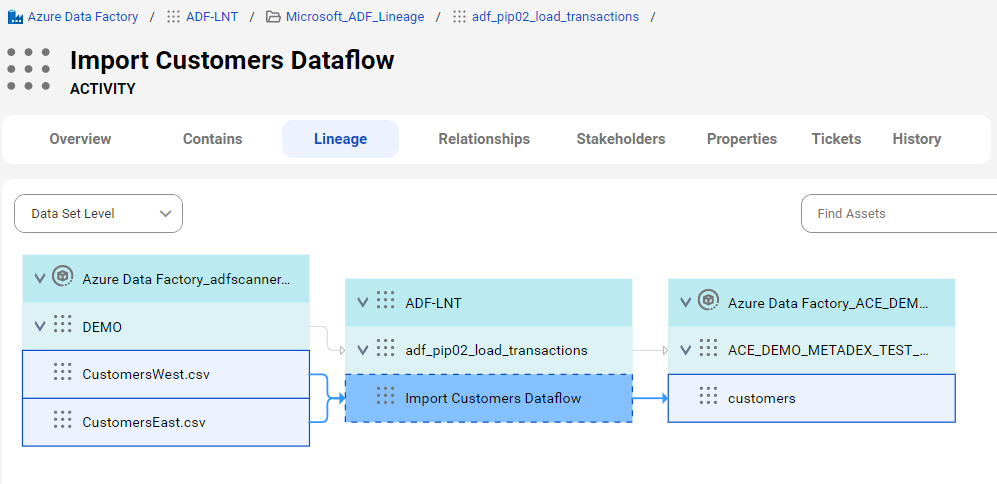
The following image shows how the Import Customers Dataflow activity gets data from two different data sets, contained in .csv files:
View lineage at the data element level
The data element level displays details of the data set level. At the data element level, you can see the input sources for expressions or commands and calculations or transformations on the data. To view data lineage at the data element level, open a technical asset, click the Lineage tab, and then verify that the level is set to Data Element Level.
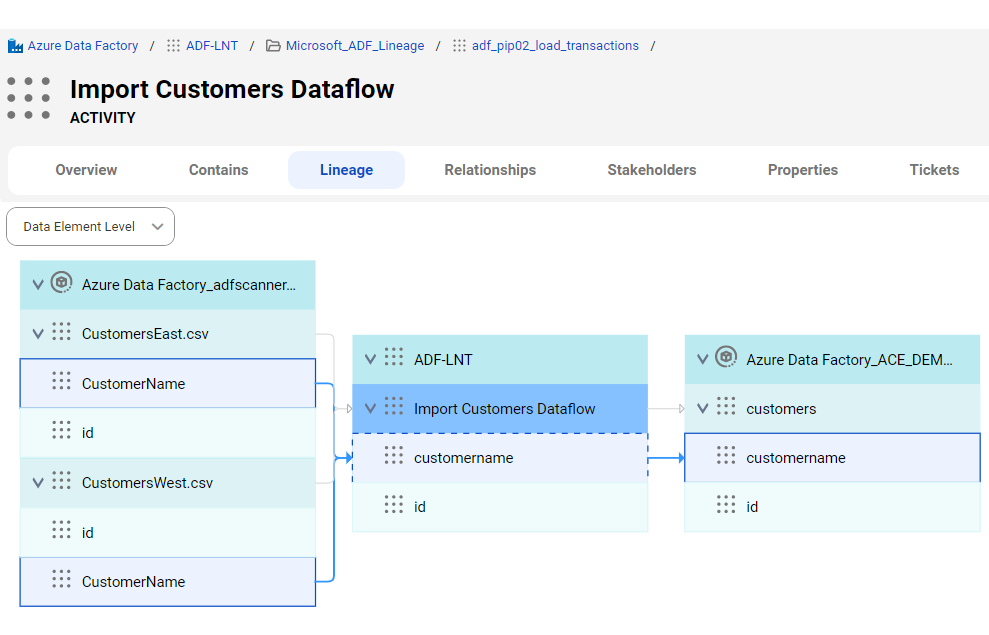
The following image shows that the Import Customers Dataflow activity uses the id and customername columns that are imported from the CustomersEast.csv and CustomersWest.csv files: