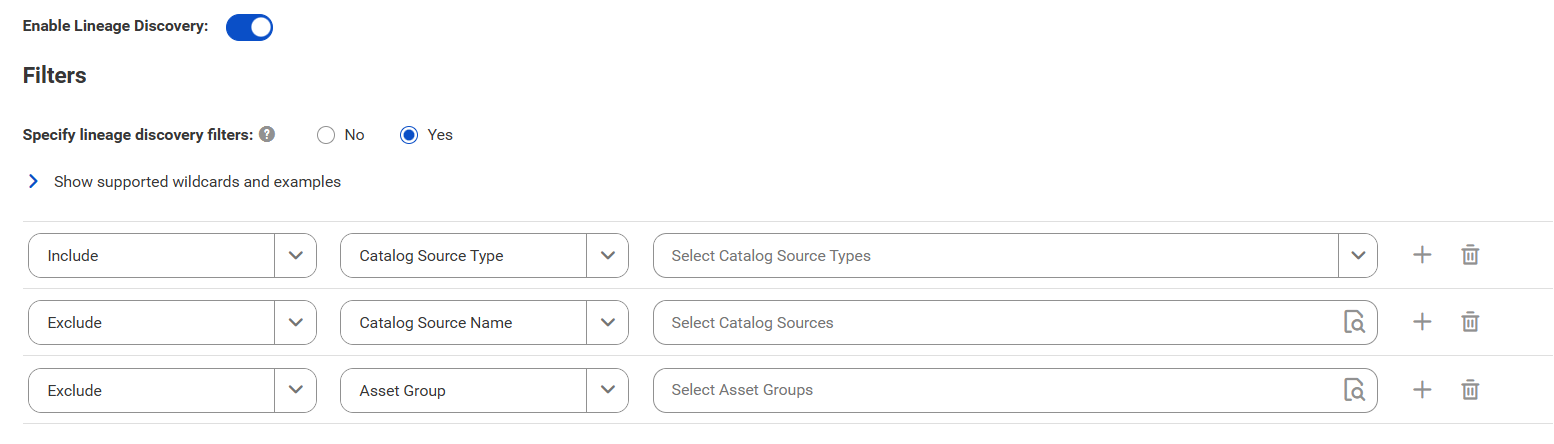
1In the Connection and Runtime area, choose a serverless runtime environment or the Secure Agent group where you want to run catalog source jobs.
Note:
Serverless runtime environment options are available if the catalog source works with a serverless runtime environment.
2Choose to retain, delete, or deprecate objects that are deleted from the source system in the catalog with the Metadata Change Option.
- - Retain. Retains objects that are deleted from the source system in the catalog. If you update or add a filter, the catalog retains objects extracted from the previous job and extracts additional objects that match the current filter. Objects deleted from the source system are not deleted from the catalog. Enrichments added on deleted objects and relationships are retained.
- - Delete. Deletes metadata from the catalog based on objects deleted from the source system and changes you make to the filter. Enrichments added on deleted objects and relationships are also permanently lost. Objects renamed in the source system are removed and recreated in the catalog.
- - Deprecate. When objects are deleted from the source system, the catalog changes the lifecycle of the imported objects to Obsolete. The lifecycle of objects also changes to Obsolete when you add exclusion filters or reduce the scope so that objects extracted in earlier jobs are no longer included. For example, the first job includes the sales schema. The second job also includes the sales schema, but excludes the sales.transactions table. In this case, the second job marks the sales.transactions object as Obsolete, even though the first job includes it. This does not impact enrichments applied to deprecated objects and relationships. Objects renamed in the source system are removed and recreated in the catalog. When you run the catalog source job again for other capabilities such as data classification, relationship discovery, or glossary association, the job doesn't consider obsolete objects. Obsolete objects remain in the catalog until they are purged when you run a Purge Obsolete Objects job on the Explore page.
Note:
You can also change the configured metadata change option when you run a catalog source.
3In the Filters area, define one or more filter conditions to extract metadata:
- aSelect Yes to view filter options.
- bFrom the Include/Exclude list, choose to include or exclude metadata based on the filter parameters.
- cFrom the object type list, select Script Path.
- dEnter the script path as the filter value.
- ▪ Use an asterisk to represent multiple characters.
- ▪ Use a question mark to represent a single character.
- ▪ If an object contains an asterisk or a question mark, enclose the symbol in double quotes.
- ▪ If a filter value contains spaces before or after the string value, enclose the value in double quotes.
- ▪ Don't use wildcards in file paths. To enter a path hierarchy, use separators, such as a period or a slash, which the source system allows.
- ▪ To include or exclude metadata from the script named script1.sql located in the path /users/opt/input/folder1/, enter: folder1/script1.sql
- ▪ To include or exclude metadata from all scripts with SQL extension stored in the path /users/opt/input/folder1/, enter: folder1/*.sql
- ▪ To include or exclude metadata from all scripts stored in the path /users/opt/input/, enter: *
- ▪ To include or exclude metadata from all scripts with SQL extension and names that start with 'script' followed by a single character, stored in the path /users/opt/input/folder1/, enter: folder1/script?.sql
- eOptionally, to define an additional filter with an OR condition, click the Add icon.
Filter values can contain wildcards. Use the following rules when you enter filter values with wildcards:
The following image shows the filter condition: 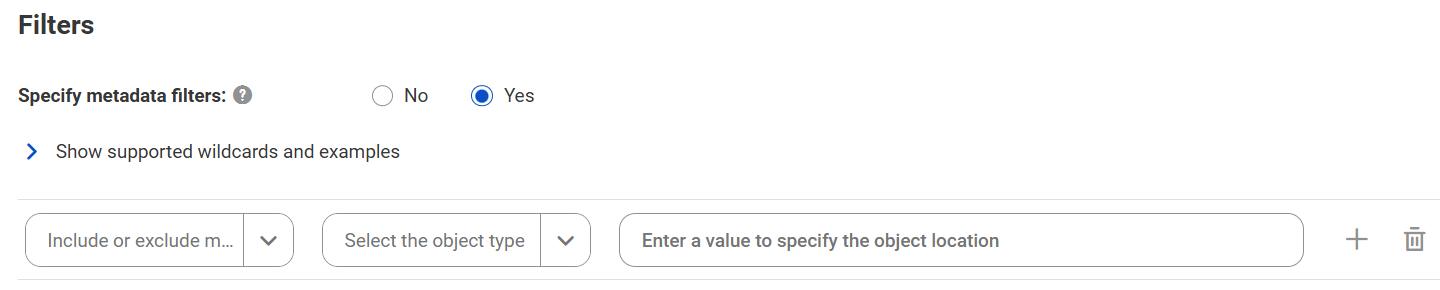
If the scripts root directory path is /users/opt/input, use the following examples to create filter conditions:
4In the Configuration Parameters area, enter configuration parameters.
The following table describes the properties that you can enter:
Property | Description |
|---|---|
Scripts Root Directory Path | Path to the remote SQL script root directory. |
Default Database | Default database for the SQL script processing. |
Default Schema | Default schema for the SQL script processing. |
MetaTables Include Filter | Advanced parameter. When you process PL/SQL statements, Metadata Command Center does not read tables or view content by default. If you want to use the content, for example, to process dynamic SQL statements, use the MetaTables Include Filter parameter. This parameter prompts the database for the required metadata. Verify that the user has SELECT permissions for metatables. Note: This parameter appears when you click Show Advanced. Note: Don't use this option to specify filters for tables that you want to include or exclude during the metadata extraction run. |
Additional Settings | Configure expert parameters to specify additional configuration options to be passed at runtime. Required if you need to troubleshoot the catalog source job. Caution: Use expert parameters when it is recommended by Informatica Global Customer Support. Note: This parameter appears when you click Show Advanced. |
5Configure additional capabilities for the catalog source by clicking on the tabs.