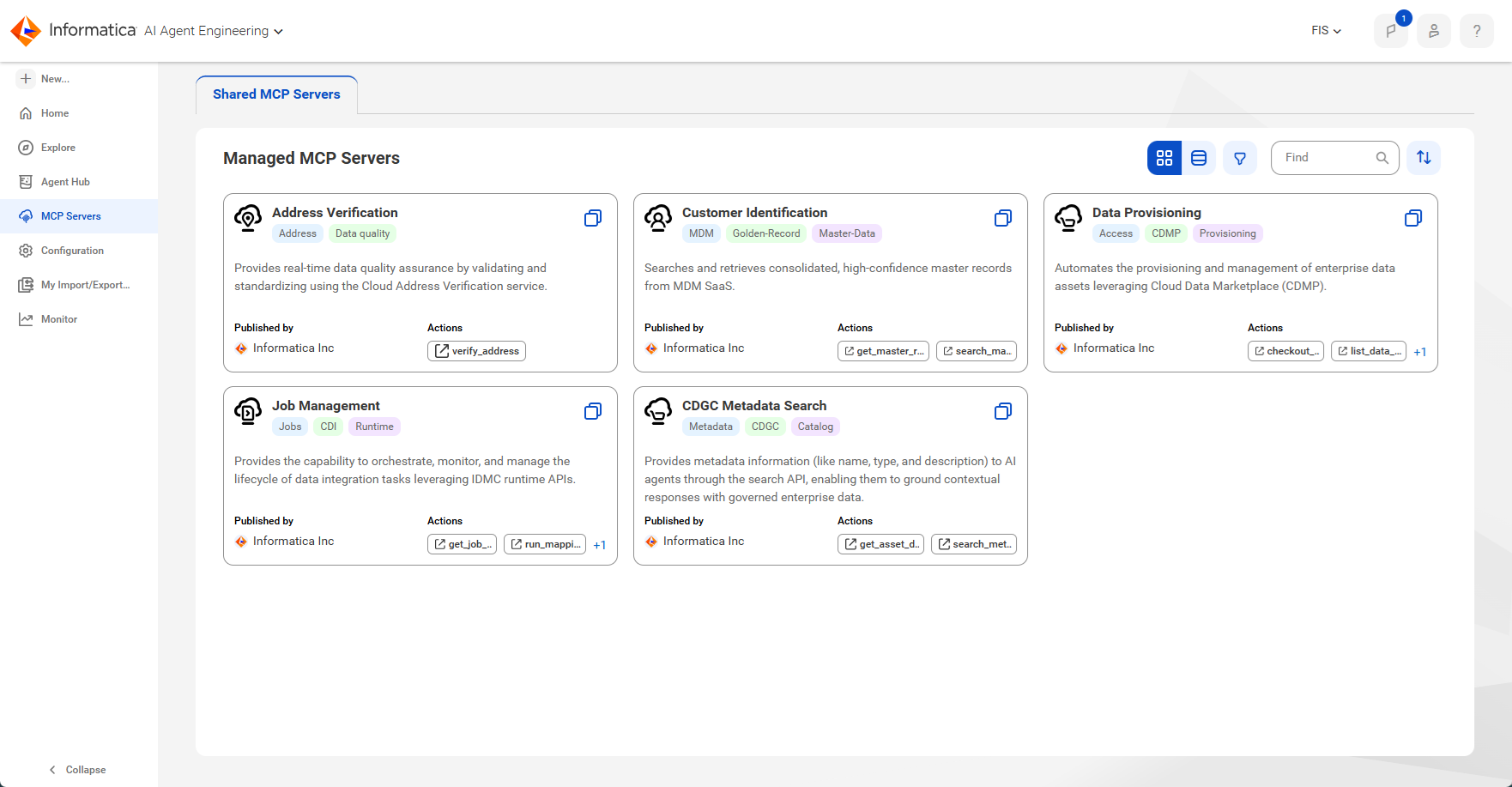
You can view the available servers on the MCP Servers page in AI Agent Engineering.
The following image shows the MCP Servers page:
The following Informatica-managed MCP servers are available:
Address Verification
Provides real-time data quality assurance by validating, standardizing, and geocoding physical addresses using the Cloud Address Verification service.
CDGC Metadata Search
Allows your AI agents to perform natural language searches to discover data assets, understand their context, and retrieve essential metadata from Cloud Data Governance and Catalog (CDGC).
Customer Identification
Provides your AI agents with a direct link to the single source of truth for customer data within Informatica Master Data Management.
Data Provisioning
Automates the provisioning and management of enterprise data assets by connecting your AI Agents to Data Marketplace, enabling them to initiate governed provisioning workflows for enterprise data assets.
Job Management
Provides the operational interface between your AI agents and the IDMC execution engine. Allows agents to orchestrate data pipelines, monitor process health, and manage task lifecycles in real-time.
Click an MCP server to view its details. The MCP server details page lists the capabilities and primary use cases, actions available, and configuration information.
Note:
The actions displayed on the MCP server details page are called "tools" in some third-party MCP servers.
Address Verification server
The Address Verification server provides real-time data quality assurance by validating, standardizing, and geocoding physical addresses using the Cloud Address Verification service.
This MCP server exposes the power of Informatica's Cloud Address Verification service as a single, simple tool for AI agents. It ensures that every address used within an AI-driven workflow, whether for generating customer leads, confirming shipping details or updating CRM records, is globally valid, standardized, and geocoded. By providing a trusted source of address data in real time, this server eliminates data quality risks and reduces operational costs associated with failed deliveries or inaccurate contact information.
Key capabilities
This MCP server offers the following key capabilities:
•Real-time validation. Verifies and corrects physical addresses for over 240 countries and territories instantaneously.
•Data quality assurance. Provides validation status to confirm deliverability and accuracy.
•Global standardization. Formats addresses according to the official postal standards of the local country.
Use cases
Use this MCP server to address the following use cases:
•Lead enrichment. Validate addresses of new leads instantly before passing them to sales or CRM systems.
•E-commerce checkout. Verify customer shipping addresses at the point of entry to prevent cart abandonment and failed deliveries.
•Field service dispatch. Ensure accurate location data for scheduling service appointments or dispatches.
•Master data management. Standardize and clean address records during data entry or bulk updates.
Actions
The following table describes the server actions:
Action
Description
verify_address
Provides real-time data quality assurance by validating and standardizing using the Cloud Address Verification service.
CDGC Metadata Search server
The CDGC Metadata Search server allows your AI agents to perform natural language searches to discover data assets, understand their context, and retrieve essential metadata from Cloud Data Governance and Catalog (CDGC).
Use this MCP server to ground your LLM responses, ensuring that your AI only works with governed, approved, and correctly-defined enterprise data assets, preventing hallucination and data misuse.
Key capabilities
This MCP server offers the following key capabilities:
•Metadata retrieval. Returns crucial metadata for grounding responses, including the asset name, type, description, and unique ID.
•AI-powered classification. Provides an understanding of data across the organization using CDGC's automated classification, for example, as personally identifiable information (PII) or financial data, as well as its associate business terms.
•Contextual grounding. Provides your AI models with the necessary enterprise context to generate trustworthy and relevant insights.
Use cases
Use this MCP server to address the following use cases:
•Data governance and compliance. Quickly identify and report on tables containing sensitive data like PII.
•Data discovery. Discover the source or related data assets to understand a data element's full context.
•LLM response grounding. Provide your AI with the exact name and description of a data asset before it executes a data query.
•Documentation and onboarding. Quickly find and summarize technical and business descriptions of key assets for new users.
Actions
The following table describes the server actions:
Action
Description
get_asset_details
Retrieves the complete, specific metadata details for a data asset. This includes lineage, profile, and full descriptions.
search_metadata
Allows AI agents to query the Informatica data catalog for enterprise data assets and returns a list of matching asset identifiers and core attributes.
Customer Identification server
The Customer Identification server provides your AI agents with a direct link to the single source of truth for customer data within Informatica Master Data Management. It enables agents to resolve identities and retrieve master records, which are consolidated profiles created from disparate source systems.
Use this server for any AI workflow that requires 360-degree view of a customer to ensure that the agent is working with the most accurate, deduplicated, and enriched customer data.
Key capabilities
This MCP server offers the following key capabilities:
•Fuzzy identity search. Uses MDM matching algorithms to find customers even with typos, nicknames, or incomplete data. For example, it can find "Jon Smyth" when searching for "John Smith".
•Truth-based grounding. Ensures LLM responses regarding customer entities are based on verified, mastered data rather than fragmented source records.
•Master record retrieval. Provides a consolidated view of customer attributes, merging data from across the enterprise into one trusted profile.
Use cases
Use this MCP server to address the following use cases:
•Customer 360 inquiries. Agents can provide a complete, unified view of a customer's profile by fetching the consolidated master record.
•Service personalization. Provides AI agents with accurate master record information to improve the quality of customer interactions.
•Data deduplication. Identifies whether a new lead already exists in MDM SaaS to prevent duplicate record creation.
•Identity verification. Validates customer identities against the master records in MDM SaaS during high-value transactions or account updates.
Actions
The following table describes the server actions:
Action
Description
get_master_record_details
Retrieves the master record based on a business ID.
search_master_record
Searches MDM SaaS to identify the business ID of the master record that best matches the provided customer details.
Data Provisioning server
The Data Provisioning server automates the provisioning and management of enterprise data assets by connecting your AI Agents to Data Marketplace.
This MCP server bridges the gap between data discovery and data utility by automating the access request process. It connects AI agents to Cloud Data Marketplace (CDMP), allowing them to initiate governed provisioning workflows for enterprise data assets. By standardizing the path from finding data to using data, this server ensures that data democratization is balanced with strict governance. It requires valid business justifications for every access request.
Key capabilities
This MCP server offers the following key capabilities:
•Automated access requests. Streamlines the process of requesting data by initiating formal workflows directly from the AI interface.
•Marketplace integration. Connects seamlessly with Data Marketplace to offer a shopping-like experience for governed data sets.
•Governance-led provisioning. Integrates with CDGC policies to ensure that all data access follows enterprise compliance standards.
Use cases
Use this MCP server to address the following use cases:
•Just-in-time data access. Allows users to ask queries like, "Get me access to the Q3 Sales dataset," and initiates the request immediately.
•Self-service analytics. Empowers business users to obtain the data they need for their BI tools without opening manual IT tickets.
•Compliance-first sourcing. Ensures that sensitive data is only provisioned after the proper approvals and justifications are recorded.
•Automated onboarding. Automatically requests access to necessary data bundles for new team members based on their roles.
Actions
The following table describes the server actions:
Action
Description
checkout_data_order
Initiates a formal access request workflow within Data Marketplace, linking users to governed data assets after submitting a business justification.
list_data_collections
Retrieves a list of data collections with optional filtering by name or by search term and selected fields.
list_delivery_targets
Retrieves detailed information about a specific data collection. You can use the optional segments query parameter to include related segments. For example: segments=all
Job Management server
The Job Management server provides the operational interface between your AI agents and the IDMC execution engine. It allows agents to orchestrate data pipelines, monitor process health, and manage task lifecycles in real time.
By exposing Data Integration controls, this MCP server enables your AI to act as an automated operator, ensuring that jobs are triggered, tracked, and managed without manual intervention.
Key capabilities
This MCP server offers the following key capabilities:
•Automated orchestration. Enables agents to trigger complex mapping tasks dynamically.
•Active job control. Provides the ability to immediately halt or stop tasks, ensuring rapid responses to identified data issues or resource constraints.
•Operational visibility. Retrieves live execution status and performance metrics, like rows processed or success/failure status, for any active job.
Use cases
Use this MCP server to address the following use cases:
•Self-healing pipelines. Allows AI agents to monitor a failed job and automatically attempt a restart or trigger a notification based on the error log.
•Job monitoring. Allows users to ask the AI for a report on their daily data loads without logging into IDMCMonitor.
•Event-driven integration. Enables AI agents to trigger specific data loads automatically when a business event, like a new file arrival, is detected.
•Resource optimization. Enables AI agents to identify and stop long-running or stalled jobs that are consuming excessive Secure Agent resources.
Actions
The following table describes the server actions:
Action
Description
get_job_status
Retrieves real-time execution states and operational statistics, including row counts and error logs, for a specific job.
run_mapping_task
Triggers job execution by initiating a specific mapping task with the required runtime parameters.
stop_running_job
Sends an immediate termination request to the Secure Agent to halt the execution of an active task.