Conditions
A condition is a data operation that a rule statement specifies for an input data value. Every rule statement contains at least one condition.
When a condition validates an input data value, the rule specification performs the action in the rule statement. If a condition cannot validate an input data value, the rule specification does not perform the action.
Configure a condition to perform one of the following types of analysis:
- Compare the input data values to a single value.
- The rule statement compares the values in the input column to the value that you enter.
- Compare the input data values to the values on another input.
- The rule statement compares the values in the input column to the values on the same row in another input column that you specify.
- Compare the input data values to the current date and time.
- The rule statement compares the values in the input column to the current date and time on the Data Integration Service host machine.
- Search for null values.
- The rule statement searches the input column for null or empty strings.
- Compare the input data values to a range of values
- The rule statement compares the values in the input column to a range of values that you enter.
- Compare the input data values to the values in a reference table.
- The rule statement compares the values in the input column to the values in a reference table. The rule statement returns a value from the reference table or a value that you enter.
- Compare the input data values to the output from a mapplet.
- The rule statement compares the values in the input column to the output from a mapplet that you select from the Model repository. You specify one or more inputs for the mapplet. You can select any input in the rule specification, including the current condition input. You can also specify a constant value as a mapplet input.
- Apply a function expression to the input data values.
- The rule statement applies a function expression that you select to the values in the input column. The Analyst tool stores the list of expressions.
Function Configuration in Conditions
You can configure the data operation in a condition as a function expression. You can also select a function expression from a list of expressions in the rule specification. Use the function options in the condition to configure or select the expression.
You can use the function options as an alternative to the inline condition options that the rule statement displays in the workspace. You can also use the function options to configure a condition that reads multiple inputs or that reads an asset from the Model repository.
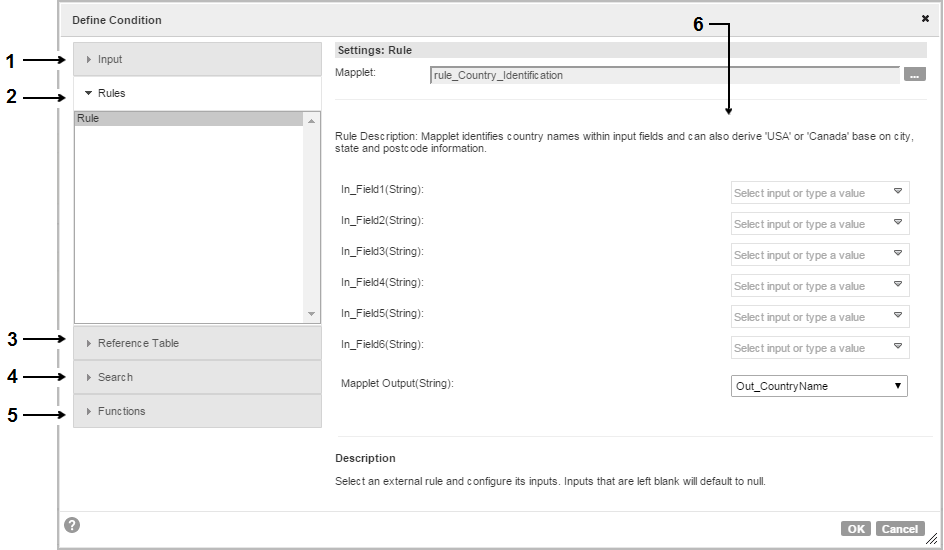
Use the Define Condition dialog box to configure or select a function expression. To open the dialog box, select function as the condition type in the rule statement.
The following image shows the Define Condition dialog box:
The dialog box contains the following options:
- 1. Input
Use the Input options to compare an input data value to other data values in the following ways:
- - Compare the rule statement input with an input from another column on the same row.
- - Compare the rule statement input with a value that you enter.
- - Compare the rule statement input with a range of values that you enter.
- 2. Rules
Use the Rules options to compare an input data value to the output from a mapplet. Use the options to select the mapplet from the Model repository. The Library workspace identifies the mapplets that you can select as rules.
- 3. Reference Table
Use the Reference Table options to compare an input data value with the values in a reference table. Use the options to select the reference table from the Model repository. The Library workspace lists the reference tables that you can select.
- 4. Search
Use the Search options to find an input data value in another input column. The rule statement searches all of the values in the column for the current rule statement input value.
- 5. Function
Use the Function options to apply a function expression to the input data. Select an expression from the list in the dialog box.
- 6. Configurable options for the operation
Use the options to configure the condition.