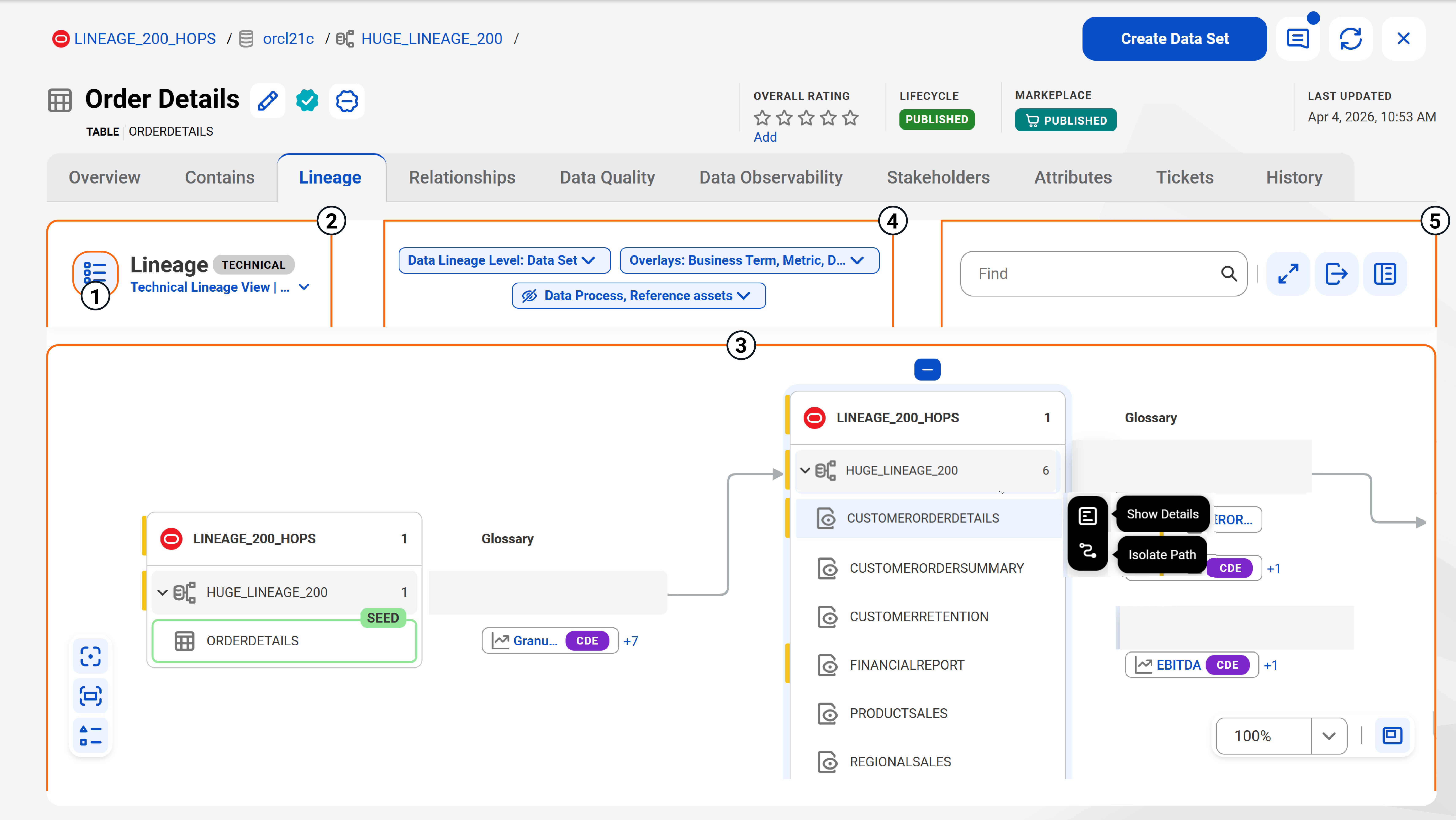
The lineage interface visualizes the data flow for an asset and provides options to filter and refine the lineage view.
To view data lineage for an asset, browse or search for a technical asset or a business asset for which you want to see the data lineage. Click the asset to open the asset details page, and go to the Lineage tab to view the data lineage for the asset.
The following image shows the lineage interface and available controls for data lineage for navigating and refining the data flow:
1Manage lineage configuration. The Manage Lineage Configuration icon opens the configuration hub for your lineage. The hub contains options to specify lineage levels, apply filters and overlays, and define the scope of your lineage. For more information, see Lineage configuration.
2Lineage views menu. The Lineage views menu shows the list of your lineage views and lets you switch between views that you have saved, default views, or the views that are shared with you. See Lineage views.
3Interface canvas. The central area displays the seed asset and its data flow. By default, the lineage initially loads as many hops as possible. If further hops exist beyond the initial load, you can click Expand Upstream or Expand Downstream to load additional hops in batches of three hops. If lineage fails to load three hops due to errors, then only one hop is loaded as a fallback mechanism. If you expand further after the error, the lineage continues to load one hop.
You can also collapse upstream or downstream nodes in a hop or collapse a selected node using the Collapse Upstream from Here, Collapse Downstream from Here, or Collapse This Node options available on the nodes in the lineage graph. However, you can't collapse the seed asset in the lineage.
If you hover over a node in the lineage, you can click the following icons:
- Click the Show Details icon to view additional details about the asset in the asset tooltip.
- Click the Isolate Path icon to highlight a specific flow in the lineage graph.
- Click the Filter Visible Elements icon to filter available data sets in the lineage graph. This icon is available only at the schema or database level.
The canvas features additional icons that you can use for precise lineage navigation, such as focusing the lineage on the seed asset, adjusting the zoom level to fit the entire lineage on the screen, and showing the legend to help you interpret the assets participating in the lineage. The Show Lineage Overview icon opens a mini map to help you orient yourself within large, complex lineage graphs.
4View lineage configurations. View the configurations applied on the current lineage view. You can see the overlays, filters, and data lineage levels that are applied on the selected lineage view.
5Lineage toolbar. The header toolbar provides the following high-level actions for the entire lineage graph:
- Find. Find assets across all pages in all the expanded hops in the lineage. When you search for an asset, the search displays the total number of matches on the current page and highlights the matching nodes along with the page numbers where other matches can be found. You can navigate through the search and click the highlighted page number to see the total number of matches on that page.
If you have applied overlays on the lineage, you can run a search on overlays. For example, if you have applied the Glossary Business Term or Business Name overlays, you can search for assets in the lineage using a business term or a business name. The search highlights the overlays containing the matching business term or business name. The search result returns the total number of matches on the current page and you can navigate through the search.
- Full Screen. Click the icon to view the lineage in full screen.
- Export. Click the icon to export the current lineage as a .PNG, .PDF, or .SVG file, or in a tabular format as an .XLSX or .CSV file.
- Show Preview. Click the icon to toggle the preview pane on the right to display more details about the selected asset in the lineage. The preview pane shows the data quality score of the asset, the profiling stats, the stakeholders of the asset, the related assets and other details of the asset.