The Home page helps you start conversations to discover and manage data with CLAIRE GPT.
Use the prompt text box to type your questions or choose from sample prompts and categories. These sample prompts and categories help you ask effective questions specific to Intelligent Data Management Cloud services. You can view your previous conversations and pin important conversations. Additionally, you can view helpful tips to make tasks easier and stay updated with the latest features.
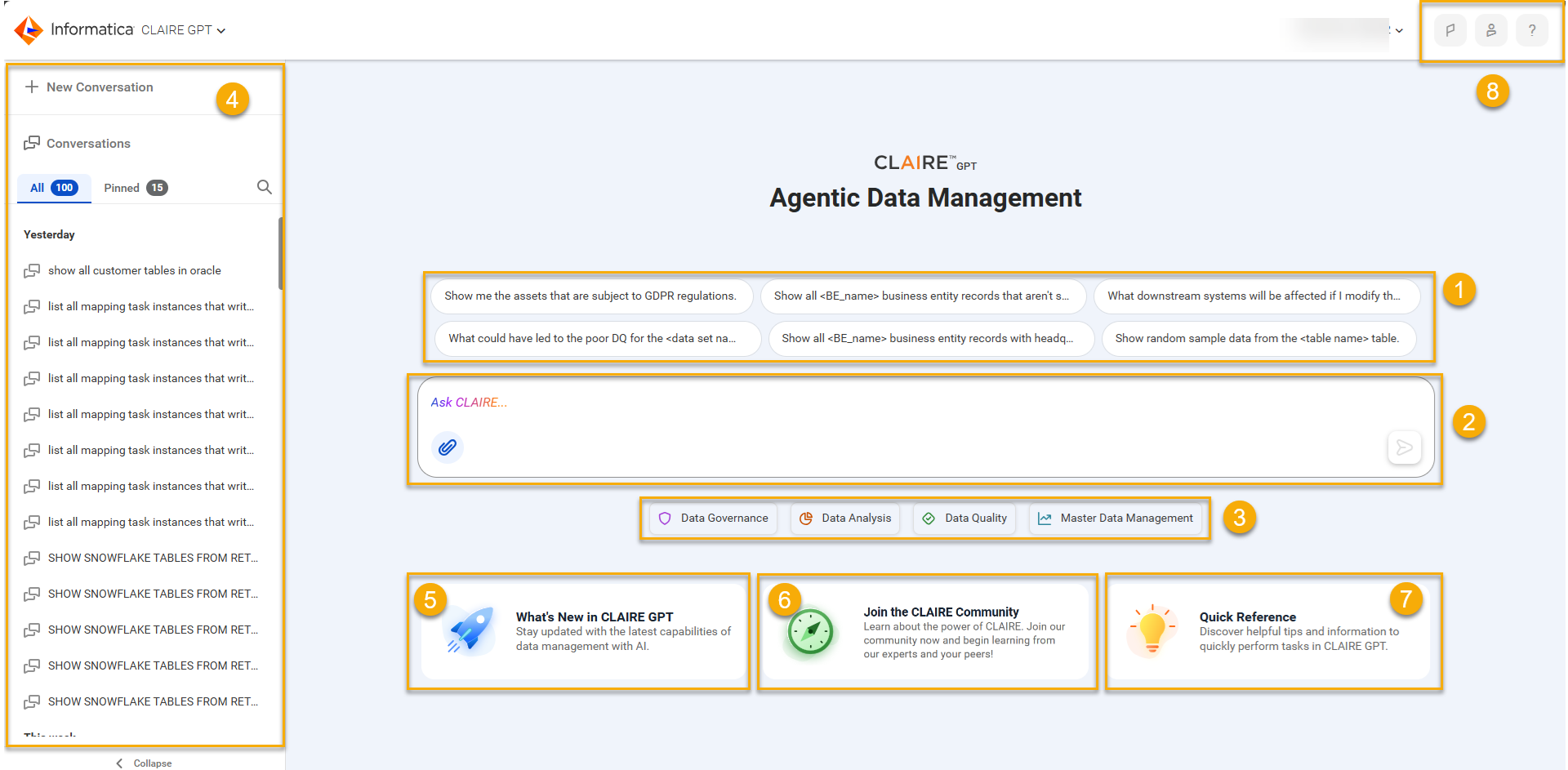
The following image shows the CLAIRE GPTHome page and its panels:
The Home page displays the following panels:
1Sample prompts
2Prompt text box
3Categories
4Navigation bar
5What's new
6Join the CLAIRE community
7Quick reference
8Notifications and user settings
Sample categories and prompts
Use the sample categories and prompts to get started with CLAIRE GPT. You can click a sample prompt or a sample prompt within a category, modify it in the prompt text box, and then press ENTER or click Submit.
Categories organize sample prompts to help you quickly find the right set of questions for your business needs. Categories include prompts related to specific Intelligent Data Management Cloud services and CLAIRE security and privacy.
Sample prompts provide easy examples that help you quickly start with CLAIRE GPT. These prompts save time and show you how to ask relevant questions.
The following categories contain prompts that you can use:
CLAIRE Security and Privacy
Includes sample prompts about data access control, compliance, security standards, data sharing, training data, and handling AI bias and hallucinations.
The following list provides some sample prompts in the CLAIRE Security and Privacy category:
- What are the data retention policies of Informatica and CLAIRE GPT?
- How does CLAIRE GPT handle hallucinations and bias?
- Provide details about Informatica IDMC certifications and compliance.
- How does CLAIRE GPT mitigate risks associated with AI usage?
Data Governance
Includes sample prompts about project overviews, identifying glossary terms lacking definitions, finding outdated or undocumented tables, tracking reports of data sources, and listing recent data quality rules.
The following list provides some sample prompts in the Data Governance category:
- Show me the data sets that have sensitive data elements from the <system name> system.
- Display a pie chart for the top five data sets in terms of the concentration of sensitive data elements.
- How many data sets have missing business descriptions? Show me the count, percentage, and breakdown by system?
- Show me the assets that are subject to GDPR regulations.
Data Quality
Includes sample prompts to identify data sets with poor quality scores, create data quality rules, analyze missing values, and track stale quality scores across tables and schemas.
The following list provides some sample prompts in the Data Quality category:
- Which categorical columns in the <table name> table have more than 10% missing values?
- Provide data quality insights for the data set <data set name>.
- What could have led to the poor DQ for the <data set name> data set?
- List the data sets that have poor data quality scores from the <system name> system.
Data Analysis
Includes sample prompts for analyzing data completeness, previewing recent records, identifying duplicates in tables, and use cases with prompts for data analysts.
The following list provides some sample prompts in the Data Analysis category:
- Analyze the critical columns of the <table name> table to determine their data sparsity or completeness.
- Show random sample data from the <table name> table.
- Show a data preview of the last 10 records from the <table name> table.
- What is the date range for the important date columns in the <table name> table?
Master Data Management
Includes sample prompts about viewing business entity records by source or status, managing Directed AI match rules, creating Customer 360 records, and tracking data quality rules and source systems.
The following list provides some sample prompts in the Master Data Management category:
- How do I create a record in Customer 360?
- Show all <BE_name> business entity records with headquarters located in <state>.
- Show all Directed AI match rules configured for the <BE_name> business entity.
- Show all <BE_name> business entity records with headquarters located in <city>.
The following list provides some sample prompts that you can use with CLAIRE GPT
•Give an overview of the contents in the <project name> project.
•List the assets with high business criticality but low data quality scores.
•What mechanisms does Informatica use to ensure transparency around data access when CLAIRE GPT performs real-time data exploration from customer data sources?
•Show all <BE_name> business entity records that don't belong to any category.
Note:
The sample prompts vary based on the data available in the catalog and MDM SaaS.
Prompt text box
Enter your prompts in the prompt text box to interact with, process, analyze, and manage data. To access a list of sample prompts, type # in the prompt text box.
Use CLAIRE GPT's intelligent prompt completion to quickly refer to assets, artifacts, users, and user groups from the suggestions that appear based on your conversation history. Intelligent prompt completion gives you suggestions based on the intent of your previous prompts and the last seen or explored assets in the conversation.
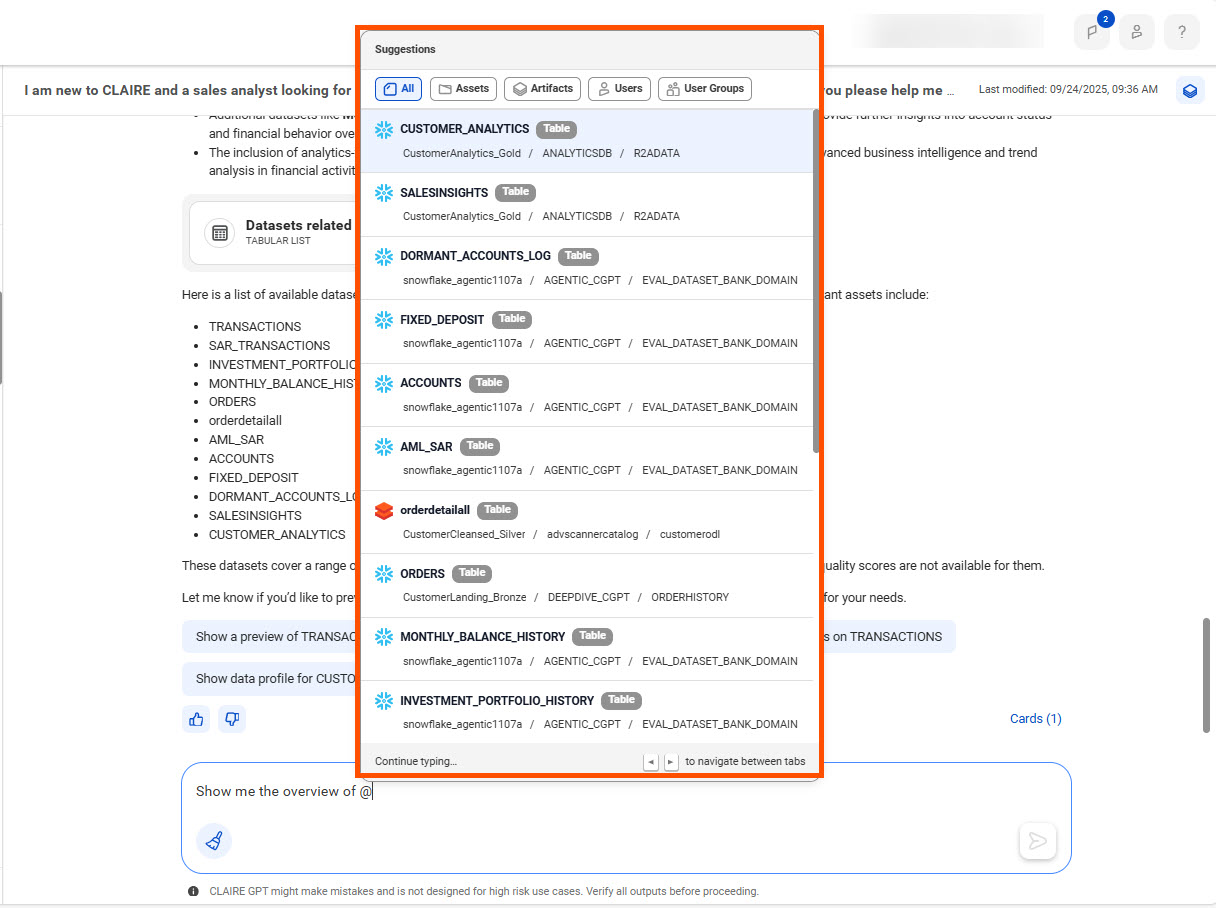
To use the intelligent prompt completion functionality, you need to first search and discover assets, artifacts, users, or user groups in the conversation and then type @ in the prompt text box. A list of suggestions based on your conversation history appears. If you continue to type the asset name, the list shortens, and you can select a suggestion from the list.
You can filter the suggestions based on the following categories:
•All
•Assets
•Artifacts
•Users
•User groups
The following image shows the suggestions that appear based on the conversation history:
If you wish to reuse a previous prompt, you can use the up and down arrow keys and recall prompts within the conversation. To try the same prompt again, you can modify it further or type retry or refresh.
If you don't want CLAIRE GPT to generate a response, you can cancel the response generation. To cancel the response generation, click the Stop generating response icon before CLAIRE GPT displays the response.
Navigation bar
Navigate to the various components of CLAIRE GPT to start conversations and view previous conversations.
Click a previous conversation to view the conversation history. You can also rename, delete, and pin a conversation.
For more information about conversations, see Conversations.
Notifications and user settings
View important notifications and view or modify user settings.
You can view notifications in CLAIRE GPT and receive email notifications. You can view alerts for unread notifications on the toolbar. Click Notifications to view the latest unread notifications in the notification tray. Click a notification to mark it as read. To view all unread notifications on the Notifications page, click View all Unread.
You can also view the user profile, user settings, and log out of CLAIRE GPT.